 Artificially generated
Amazon CRO: 73 percent click only the first listing
Conversion rate optimization on Amazon is not a nicer hero image and a lower price. It is diagnosis, then a test that costs months.
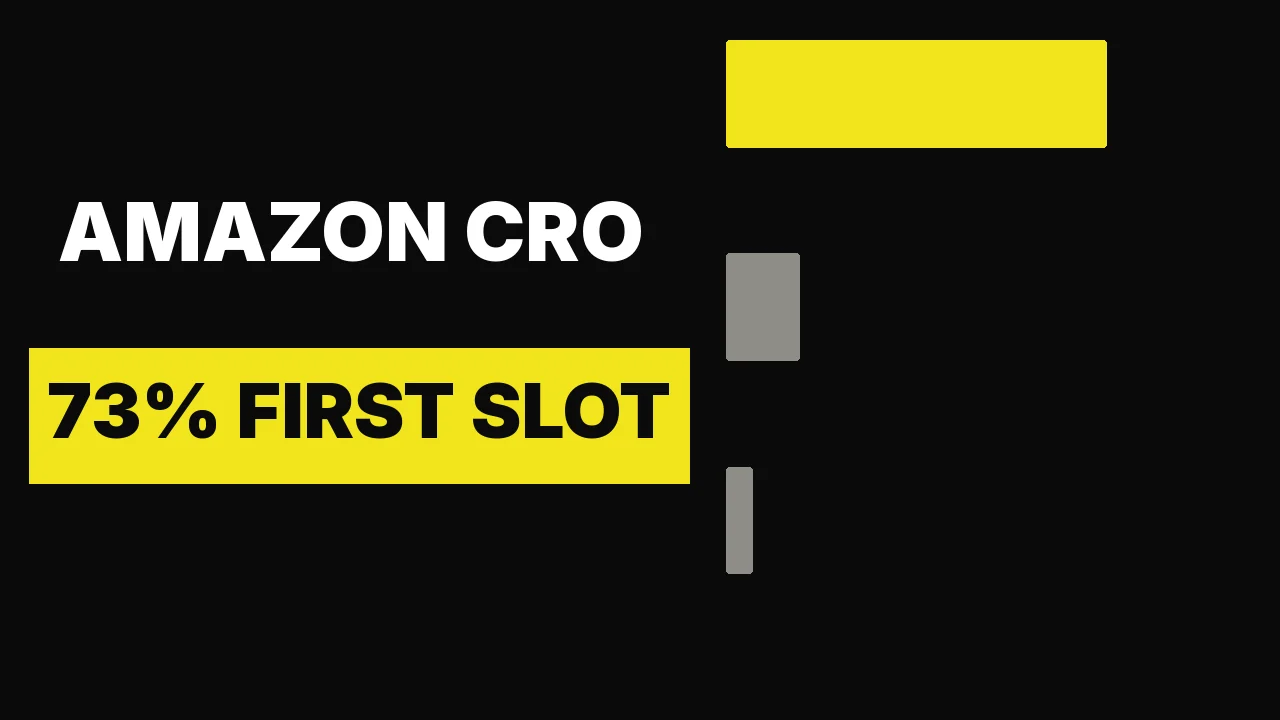
Amazon CRO means you measure where shoppers drop and you change that exact spot. Jungle Scout asked more than 1,000 shoppers: 73 percent click the first search result, 14 percent the second, 5 percent the third. Conversion Rate Experts took the same research-and-testing discipline they use on websites and, in 2026, laid it on Amazon listings. A native A/B test on Amazon takes eight to twelve weeks in their practice, and you get one of those at a time per product.
Slot one is not a fifty-times-better product. It is a millisecond edge that compounds.
Search “iPhone cases 17 Pro Max” on Amazon.com and you get more than 10,000 results. Page five is invisible. Front of page one gets clicks, sales, reviews, and the next tests finish faster because more people see the variant.
Conversion Rate Experts cites Noah Lyles’ 100 m win in 2024: five milliseconds. You do not need to be twice as good as second place. You need to be slightly better in the few places a shopper actually reads: search row and listing page.
You do not change a listing until you know which organ is sick.
Conversion Rate Experts calls this DiPS: Diagnose, Problem, Solution. No medicine without a finding. On Amazon that rule is harder than on your own site, because the shopper has ten other listings in the same search.
Seller Central gives you three numbers that split the funnel:
Click-through rate is sessions divided by impressions. Conversion Rate Experts puts well-ranked organic listings roughly between 2 and 5 percent CTR. Below 2 percent with healthy impressions: shoppers see you and scroll on. Then the work sits in title, main image, search-row price, not in the bullet list.
Unit Session Percentage under 8 to 12 percent, with healthy sessions: the page does not close. Then images, bullets, reviews and on-page price come first.
Split by source. A listing that converts on branded search and dies on sponsored clicks often has a targeting problem, not a copy problem. Then the ad comes before the listing.
The best test hypotheses sit in the reviews. Including the competitor’s.
Conversion Rate Experts works with five questions. You ask buyers who almost did not buy, because true non-buyers in Amazon traffic are mixed with people who were never in the category.
- Where exactly did you first find out about us?
- What persuaded you to purchase from us?
- Which other options did you consider before choosing our product?
- What is the one thing that nearly stopped you buying from us?
- What was your biggest challenge finding the right product online?
Amazon owns checkout and template. Your site, your email list, Reddit, Trustpilot, support chats and Amazon reviews stay yours. Competitor reviews are often clearer than your own, because nobody is polite to a stranger’s product.
A lock that keeps showing up in reviews is not “we need better images.” Laptop stand: shoppers fear wobble. The problem is stability. Six keys for the same lock: heavy machine in the photo, close-up of the joint, max weight in the first bullet, comparison against wobbly stands, a line on why the geometry holds, customer proof in A+ content.
Insight, problem, counter, Amazon change. In that order. Never the other way.
Amazon gives you six levers. Almost all persuasion lives there.
| Lever | Native A/B test | Why it matters |
|---|---|---|
| Main image | Yes | Only creative that sits in search and on the page |
| Title | Yes | First line of the value proposition |
| Bullets / description | Yes | Test the block, not one sentence at a time |
| A+ / Premium A+ | Yes | Proof below the fold; highest-traffic listing first |
| Price and promos | No | Amazon shows everyone the same price at the same time |
| Image stack (not main) | No | Lifestyle, infographic, comparison: off-platform only |
Amazon’s economist explained the price case: nondiscriminatory pricing. Everyone sees the same price at the same time. So no visitor-level split, only over time, and that is not an A/B test in Manage Your Experiments.
Reviews are the seventh lever, and the dangerous one. Amazon’s Communication Guidelines ban paid five-stars and funneling only happy buyers into the ask. That risks the account. The clean path: deliver what the listing promised. Then you may ask for a review.
One test per listing. Eight to twelve weeks. Calling a winner at week two burns the year.
On your own site you can run parallel experiments. On Amazon: one experiment at a time per product. Conversion Rate Experts sees high-traffic listings reach significance in four weeks at the earliest, the rest in eight to twelve, often longer.
That is why they bundle changes into one variation. A new main image plus a rewritten first bullet plus an A+ module that backs the same counter. Meek tweaks never reach significance on this calendar, and they kill the team’s patience.
Before Amazon: user tests and A/B usability. The same people who narrated the old listing see mockups. Four or five rounds in two weeks are possible. What clearly loses there does not burn an Amazon slot.
Catalog trick: similar SKUs, different tests. That is the only parallelism Amazon gives you.
What is fixed, what CRE takes from practice, what is seller folklore
| Bin | Claim | Source |
|---|---|---|
| Fact | 73 / 14 / 5 percent clicks on slots 1, 2, 3 (self-report, 1,000+ shoppers) | Jungle Scout, via CRE 2026 |
| Fact | One experiment at a time per listing in Manage Your Experiments | Amazon Seller Central, CRE |
| Fact | Price cannot be randomized in Manage Your Experiments; same price for everyone at the same time | Amazon Science, Price experiments |
| Fact | Secondary images have no native split of their own | CRE Playbook 2026 |
| Estimate | Organic CTR often 2 to 5 percent, Unit Session Percentage often 8 to 12 percent, category-dependent | CRE, typical band, not an Amazon spec sheet |
| Estimate | Significance often after 8 to 12 weeks, high traffic from 4 | CRE practice; Amazon copy says “as soon as four weeks” |
| Folklore | “Better images, punchier bullets, lower price” as a sequence with no diagnosis | Seller blogs, described by CRE as guessing |
Read the funnel. Tag the reviews. Build one fat experiment. Pre-sort it off-platform.
Open Seller Central and write impressions, sessions, Unit Session Percentage for your strongest keyword. Is the break before the click or after?
Take 100 reviews, yours and number two’s. Mine questions 2 to 5. Question 1 often stays empty on Amazon, because “I was in search” feels obvious.
Buy your own product on Amazon. Unpack it. Compare the listing to the box. If you would not recommend the experience to a friend, the reason sits somewhere between title and delivery.
Build one experiment around the biggest lock. Main image that breaks that lock, plus first bullet, plus one A+ block. Run the stack past five people with fresh eyes. Then the Amazon slot, and then you wait.
Conversion Rate Experts wrote the playbook. The rest is craft: the same discipline as on your own site, on a calendar that gives you three or four real answers per listing per year.